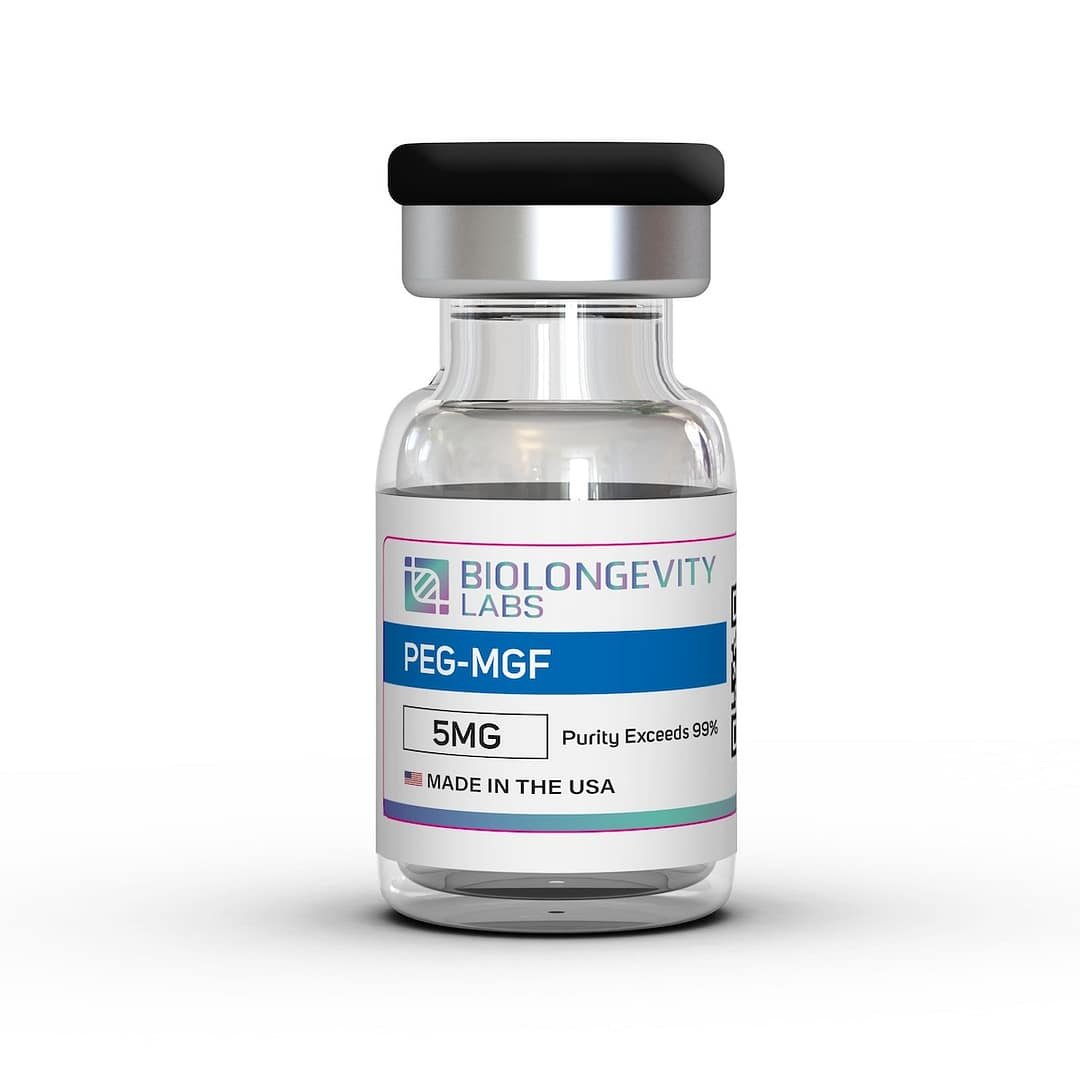
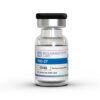
Buy PEG-MGF (5mg)
PEG-MGF Product Description
PEG MGF (Pegylated Mechano Growth Factor) is a synthetic, modified form of MGF, which is a split variant of Insulin-like Growth Factor-1 (IGF-1). Through a process called pegylation, a polyethylene glycol (PEG) molecule is attached to the MGF peptide, significantly enhancing its stability for research use.
This peptide preferentially targets recently stressed or damaged muscle cell tissue, making it particularly suited for laboratory studies investigating muscle growth, repair and recovery.
Peptide Information
| Property | Value |
|---|---|
| Peptide Sequence | PEG-Tyr-Gln-Pro-Pro-Ser-Thr-Asn-Lys-Asn-Thr-Lys-Ser-Gln-Arg-Arg-Lys-Gly-Ser-Thr-Phe-Glu-Glu-Arg-Lys |
| Molecular Formula | C121H200N42O39 |
| Molecular Weight | 2900 g/mol |
| CAS Number | 108174-48-7 |
| PubChem CID | 178101669 |
| Synonyms | IGF-1 Ec E-peptide, MGF-E, Pegylated MGF, PEG-MGF-Ct24E, PEG Myotrophin |
Lyophilized Peptides:
These peptides are freeze-dried, a process that not only extends shelf life but also preserves the purity and integrity of the peptides during storage. We do not use any fillers in this process.
Product Usage:
This PRODUCT IS INTENDED AS A RESEARCH CHEMICAL ONLY. This designation allows the use of research chemicals strictly for in vitro testing and laboratory experimentation only. All product information available on this website is for educational purposes only. This product should only be handled by licensed, qualified professionals. This product is not a drug, food, or cosmetic and may not be misbranded, misused or mislabeled as a drug.
PEG MGF Research
PEG-MGF demonstrates significant potential across multiple regenerative applications. The research explores its effectiveness in muscle repair and regeneration, bone and cartilage healing, stem cell regulation and protective effects in both neural and cardiac tissues.
Musculoskeletal Regeneration and Muscle Repair
MGF has been shown to enhance satellite cell activation, proliferation, and fusion in human muscle progenitor cells. The peptide can delay cellular senescence and improve muscle repair, suggesting potential for combating age-related muscle loss and improving myogenic precursor cell transplantation outcomes in conditions like Duchenne muscular dystrophy.[1]
Bone and Cartilage Repair
MGF promotes osteoblast proliferation, differentiation, and mineralization, and significantly enhance bone defect healing in animal models.[2]
In cartilage repair, MGF combined with TGF-β3 in silk fibroin scaffolds increases stem cell recruitment and chondrogenic differentiation, leading to improved articular cartilage regeneration and integration in rabbit models.[3]
Stem Cell Migration and Differentiation
MGF E peptides regulate the migration and differentiation of bone marrow mesenchymal stem cells (BMSCs). While they do not affect BMSC proliferation, they enhance migration and shift differentiation toward adipogenesis over osteogenesis, mediated via the IGF1 receptor and Erk1/2 signaling pathway.[4]
Neuroprotection and Cardiac Repair
The C-terminal peptide of MGF demonstrates strong neuroprotective effects in models of brain ischemia, functioning independently of the IGF-1 receptor and providing prolonged neuronal protection compared to full-length IGF-1.[5] In cardiac tissue, localized delivery of the MGF E-domain peptide via polymeric microstructures after myocardial infarction improves cardiac function, reduces mortality, and prevents adverse remodeling.[6]
References
- Kandalla, P., Goldspink, G., Butler-Browne, G., & Mouly, V. (2011). Mechano Growth Factor E peptide (MGF-E), derived from an isoform of IGF-1, activates human muscle progenitor cells and induces an increase in their fusion potential at different ages. Mechanisms of Ageing and Development, 132, 154-162. https://doi.org/10.1016/j.mad.2011.02.007.
- Wei, W., Liu, S., Song, J., Feng, T., Yang, R., Cheng, Y., Li, H., & Hao, L. (2020). MGF-19E peptide promoted proliferation, differentiation and mineralization of MC3T3-E1 cell and promoted bone defect healing.. Gene, 144703 . https://doi.org/10.1016/j.gene.2020.144703.
- Luo, Z., Jiang, L., Xu, Y., Li, H., Xu, W., Wu, S., Wang, Y., Tang, Z., Lv, Y., & Yang, L. (2015). Mechano growth factor (MGF) and transforming growth factor (TGF)-β3 functionalized silk scaffolds enhance articular hyaline cartilage regeneration in rabbit model.. Biomaterials, 52, 463-75 . https://doi.org/10.1016/j.biomaterials.2015.01.001.
- Cui, H., Yi, Q., Feng, J., Yang, L., & Tang, L. (2014). Mechano growth factor E peptide regulates migration and differentiation of bone marrow mesenchymal stem cells.. Journal of molecular endocrinology, 52 2, 111-20 . https://doi.org/10.1530/JME-13-0157.
- Dłużniewska, J., Sarnowska, A., Beręsewicz, M., Johnson, I., Srai, S., Ramesh, B., Goldspink, G., Górecki, D., & Zabłocka, B. (2005). A strong neuroprotective effect of the autonomous C‐terminal peptide of IGF‐1 Ec (MGF) in brain ischemia. The FASEB Journal, 19. https://doi.org/10.1096/fj.05-3786fje.
- Peña, J., Pinney, J., Ayala, P., Desai, T., & Goldspink, P. (2015). Localized delivery of mechano-growth factor E-domain peptide via polymeric microstructures improves cardiac function following myocardial infarction.. Biomaterials, 46, 26-34 . https://doi.org/10.1016/j.biomaterials.2014.12.050.
PEG-MGF (260699)
 ×
×
Disclaimer: For Research Purposes Only
This content is provided strictly for research purposes and does not constitute an endorsement or recommendation for the non-laboratory application or improper handling of peptides designed for research. The information, including discussions about specific peptides and their researched benefits, is presented for informational purposes only and must not be construed as health, clinical, or legal guidance, nor an encouragement for non-research use in humans. Peptides described here are solely for use in structured scientific study by authorized individuals. We advise consulting with research experts, medical practitioners, or legal counsel prior to any decisions about obtaining or utilizing these peptides. The expectation of responsible, ethical utilization of this information for legitimate investigative and scholarly objectives is paramount. This notice is dynamic and governs all provided content on research peptides. . .
Related products