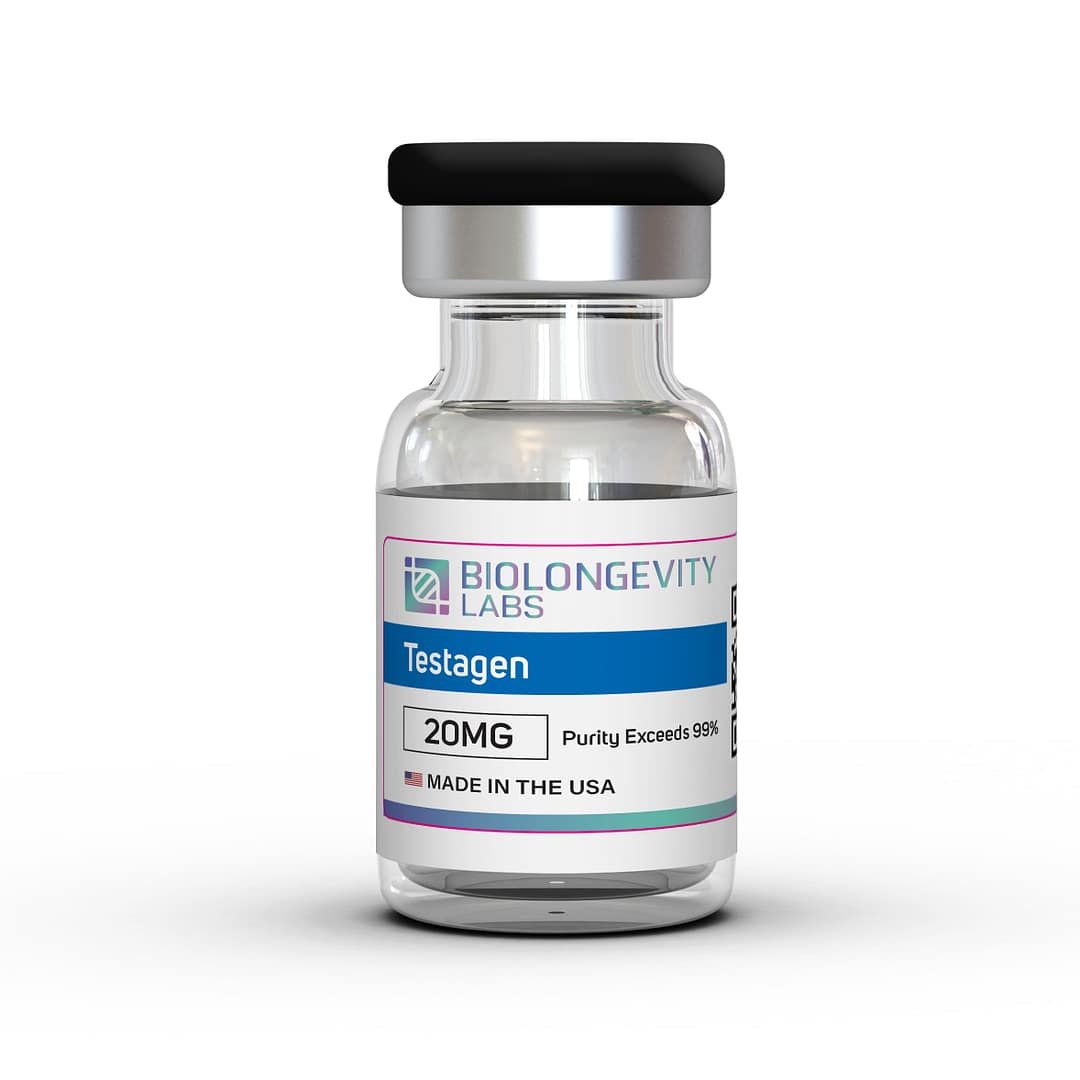
Buy Testagen Peptide (20mg)
Testagen Peptide Description
As part of the established Khavinson short peptide bioregulators family, Testagen supports researchers studying endocrine system regulation at the molecular level. This four amino acid sequence penetrates cellular membranes to interact directly with DNA, making it suitable for gene expression research.
Laboratory studies show Testagen can modulate pituitary gland function and influence testosterone levels in experimental models. The synthetic peptide delivers consistent signal transduction pathways for examining thyroid gland morphology and hormonal balance mechanisms. Quality testing protocols ensure product specifications meet precise research requirements in cellular biology and endocrinology studies.
Peptide Information
| Property | Value |
|---|---|
| Peptide Sequence | H-Lys-Glu-Asp-Gly-OH |
| Molecular Formula | C₁₇H₂₉N₅O₉ |
| Molecular Weight | 447.2 g/mol |
| CAS Number | 75007-24-8 |
Product Usage:
This PRODUCT IS INTENDED AS A RESEARCH CHEMICAL ONLY. This designation allows the use of research chemicals strictly for in vitro testing and laboratory experimentation only. All product information available on this website is for educational purposes only. This product should only be handled by licensed, qualified professionals. This product is not a drug, food, or cosmetic and may not be misbranded, misused or mislabeled as a drug.
Testagen Research
Scientific investigations into Testagen (KEDG) reveal multiple mechanisms of action across cellular transport, endocrine regulation, and gene expression pathways. Laboratory studies confirm the peptide’s ability to penetrate cellular membranes and interact directly with DNA, supporting its classification as a bioregulatory peptide with tissue-specific effects.
Cellular Transport and Bioavailability
Testagen shows high binding affinity to LAT1, LAT2, and PEPT1 transporters, which handle cellular uptake of amino acids and small peptides. The peptide’s structural design, with negatively charged residues at the N-terminus and neutral residues at the C-terminus, makes it one of the most effective transporter ligands among ultrashort peptides[1].
Molecular modeling confirms that these transporter binding sites accommodate KEDG transport efficiently. This cellular uptake mechanism may contribute to the peptide’s ability to inhibit amino acid transporters commonly overexpressed in cancer cell models.
Endocrine and Thyroid Function Research
Studies in hypophysectomized chicken models show that KEDG prevents thyroid gland atrophy and normalizes tissue morphology. The peptide counteracts pathological changes including enlarged follicles, colloid accumulation, and altered thyrocyte structure that typically occur after hypophysectomy[2].
KEDG functions through interaction with the hypothalamic-pituitary-thyroid axis as a hypophyseal-derived regulatory molecule. This mechanism maintains thyroid structural integrity through direct tissue-specific effects rather than traditional feedback pathways[3].
Nuclear Interaction and Gene Expression
Research shows that fluorescence-labeled short peptides penetrate cell nuclei and interact specifically with DNA structures. KEDG’s amino acid sequence and charge distribution may support nuclear localization and subsequent DNA binding activities[4].
The related KEDW peptide (differing by one amino acid) binds along DNA’s major groove and regulates expression of differentiation factors including PDX1, NGN3, PAX6, and FOXA2 in pancreatic cell models. Physical studies using UV-visible absorption and circular dichroism confirm stable DNA-peptide complex formation[5].
Cellular Differentiation Research
Short peptides play important roles in biological information transmission during cell differentiation processes. The KED component (closely related to KEDG) increases Nestin expression, a neurofilament protein found in early neuronal precursors, when applied to human periodontal ligament stem cells[6].
This differentiation-promoting activity suggests KEDG may work through epigenetic mechanisms that influence gene expression patterns directing stem cell fate decisions. The peptide’s ability to enhance neuronal differentiation markers indicates potential applications in tissue engineering research targeting neural repair.
Immune System Studies
KEDG treatment normalizes immune parameters in neonatally hypophysectomized chicken models where immune dysfunction develops following hypophyseal removal. The immunoregulatory effects are particularly pronounced in young animals compared to mature subjects[2].
The immune restoration mechanism involves direct interaction with immune system components rather than indirect hormonal modulation. This suggests specific binding sites on immune cells that respond to the tetrapeptide structure.
Age-Related Response Patterns
Research reveals age-dependent response patterns, with stronger therapeutic benefits in younger organisms. Neonatal hypophysectomized subjects show more pronounced corrective effects on thyroid morphology and immune function compared to one-year-old subjects[7].
This age-related efficacy pattern indicates that KEDG may work through developmental regulatory pathways that remain more responsive in younger biological systems.
References
- V. K. Khavinson, N. S. Linkova, A. I. Rudskoy, and M. G. Petukhov, “Feasibility of Transport of 26 Biologically Active Ultrashort Peptides via LAT and PEPT Family Transporters,” MDPI AG, Mar. 2023. doi: 10.3390/biom13030552. https://doi.org/10.3390/biom13030552
- B. Kuznik, A. V. Pateiuk, N. S. Rusaeva, L. M. Baranchugova, and V. I. Obydenko, “[Effects of hypophyseal Lys-Glu-Asp-Gly and Ala-Glu-Asp-Gly synthetic peptides on immunity, hemostasis, morphology and functions of the thyroid gland in neonatally hypophysectomized chicken and one-year-old birds].,” Patologicheskaia fiziologiia i eksperimental’naia terapiia, vol. 1, pp. 14–8, 2010.
- B. I. Kuznik, A. V. Pateyuk, and N. S. Rusaeva, “Effect of tetrapeptides Lys-Glu-Asp-Gly and Ala-Glu-Asp-Gly on the structure and function of the thyroid gland in neonatally hypophysectomized chickens,” Springer Science and Business Media LLC, Jan. 2008. doi: 10.1007/s10517-008-0033-6. https://doi.org/10.1007/s10517-008-0033-6
- L. I. Fedoreyeva, I. I. Kireev, V. Kh. Khavinson, and B. F. Vanyushin, “Penetration of short fluorescence-labeled peptides into the nucleus in HeLa cells and in vitro specific interaction of the peptides with deoxyribooligonucleotides and DNA,” Pleiades Publishing Ltd, Nov. 2011. doi: 10.1134/s0006297911110022. https://doi.org/10.1134/s0006297911110022
- V. Kh. Khavinson, S. M. Tendler, N. A. Kasyanenko, and S. I. Tarnovskaya, “Tetrapeptide KEDW Interacts with DNA and Regulates Gene Expression,” New World Publishing International, Inc., Jul. 2015. doi: 10.5099/aj150300156. https://doi.org/10.5099/aj150300156
- S. Caputi et al., “Effect of short peptides on neuronal differentiation of stem cells,” SAGE Publications, Jan. 2019. doi: 10.1177/2058738419828613. https://doi.org/10.1177/2058738419828613
- B. I. Kuznik, A. V. Pateyuk, N. S. Rusaeva, L. M. Baranchugova, and V. I. Obydenko, “The effect of Lys-Glu-Asp-Gly and Ala-Glu-Asp-Gly peptides on hormone activity and the thyroid structure in sexually mature and old hypophysectomized birds,” Pleiades Publishing Ltd, Oct. 2011. doi: 10.1134/s2079057011040072. https://doi.org/10.1134/s2079057011040072
Testagen(12099)

Testagen (260265)

Endotoxin Testagen

Testagen (251541)

Testagen (251541E)
 ×
×
Disclaimer: For Research Purposes Only
This content is provided strictly for research purposes and does not constitute an endorsement or recommendation for the non-laboratory application or improper handling of peptides designed for research. The information, including discussions about specific peptides and their researched benefits, is presented for informational purposes only and must not be construed as health, clinical, or legal guidance, nor an encouragement for non-research use in humans. Peptides described here are solely for use in structured scientific study by authorized individuals. We advise consulting with research experts, medical practitioners, or legal counsel prior to any decisions about obtaining or utilizing these peptides. The expectation of responsible, ethical utilization of this information for legitimate investigative and scholarly objectives is paramount. This notice is dynamic and governs all provided content on research peptides. . .
Related products