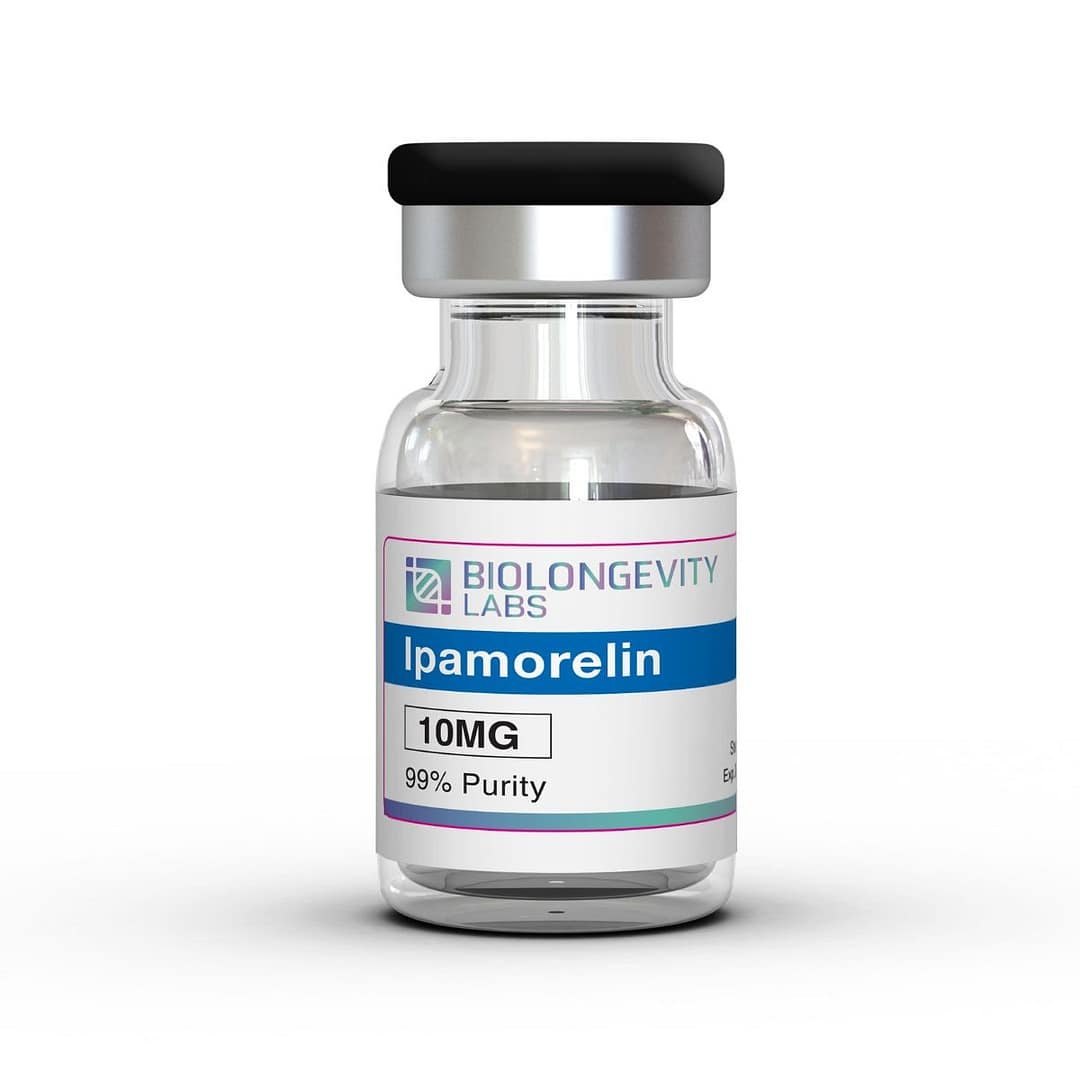
Ipamorelin (10mg)
$55.98
Ipamorelin is a synthetic peptide used in laboratory research to study growth hormone secretagogue mechanisms. This growth hormone-releasing peptide (GHRP) demonstrates selective receptor binding properties, making it valuable for examining pituitary signaling pathways in controlled research settings.
Buy Ipamorelin (10mg)
Ipamorelin Product Description
Ipamorelin is a synthetic peptide studied extensively as a growth hormone secretagogue in laboratory research. This compound belongs to the growth hormone-releasing peptide (GHRP) class and serves as a research tool for examining pituitary receptor interactions and growth hormone release mechanisms.
Ipamorelin is a pentapeptide (composed of 5 amino acids) that functions as a ghrelin mimetic in experimental models. Developed in the 1990s for research applications, this compound demonstrates selective growth hormone release properties without affecting other pituitary hormones, distinguishing it from earlier-generation peptides in laboratory studies.
The compound shows high specificity for the GHS-R1a receptor, enabling targeted investigation of physiological responses in vitro. Its selective mechanism has established it as a valuable research tool for investigating growth hormone signaling pathways, metabolic regulation, and receptor-ligand interactions in scientific studies.
Peptide Information
| Property | Value |
|---|---|
| Peptide Sequence | Aib-His-D-2Nal-D-Phe-Lys |
| Molecular Formula | C38H49N9O5 |
| Molecular Weight | 711.9 g/mol |
| CAS Number | 170851-70-4 |
| PubChem CID | 9831659 |
| Synonyms | 170851-70-4, Ipamorelin [INN], NNC-26-0161, UNII-Y9M3S784Z6 |
Lyophilized Peptides:
These peptides are freeze-dried, a process that not only extends shelf life but also preserves the purity and integrity of the peptides during storage. We do not use any fillers in this process.
Product Usage:
This PRODUCT IS INTENDED AS A RESEARCH CHEMICAL ONLY. This designation allows the use of research chemicals strictly for in vitro testing and laboratory experimentation only. All product information available on this website is for educational purposes only. This product should only be handled by licensed, qualified professionals. This product is not a drug, food, or cosmetic and may not be misbranded, misused or mislabeled as a drug, food or cosmetic.
Ipamorelin Research
Ipamorelin is a selective growth hormone secretagogue that has been studied extensively for its unique receptor binding properties and physiological mechanisms in laboratory settings.
Growth Hormone Receptor Interactions
Ipamorelin operates through selective binding to ghrelin receptors, triggering pulsatile growth hormone release that mirrors natural secretion patterns[1]. The peptide’s molecular structure allows specific receptor activation without cross-reactivity across other hormonal pathways.
Studies show ipamorelin stimulates GH release while leaving ACTH, cortisol, prolactin, and thyroid hormones unaffected[1]. This selectivity makes it valuable for controlled laboratory experiments examining isolated growth hormone effects.
Skeletal Research Applications
Laboratory studies examining bone tissue demonstrate ipamorelin’s effects on bone mineral content and dimensional growth. Research indicates the peptide influences periosteal bone formation through growth hormone-mediated pathways[2].
In controlled settings, ipamorelin counteracted glucocorticoid-induced bone degradation by activating formation pathways. These findings support research into bone remodeling mechanisms at the cellular level[3].
Metabolic Pathway Studies
Growth hormone released through ipamorelin activation influences lipolytic pathways in adipose tissue. Laboratory analyses show increased free fatty acid circulation and altered glucose metabolism patterns[4].
Research examining insulin sensitivity pathways reveals complex interactions between GH signaling and metabolic regulation. These mechanisms remain areas of active in vitro investigation.
Cellular Repair Mechanisms
Studies exploring tissue regeneration hint at ipamorelin’s potential role in collagen synthesis pathways. The growth hormone-IGF-1 axis activated by the peptide appears to influence cellular proliferation and protein synthesis[5].
Laboratory work shows angiogenic pathway activation and enhanced tissue remodeling processes. These mechanisms support research into cellular recovery and regeneration at the molecular level.
Gastrointestinal Research
Laboratory studies have investigated Ipamorelin‘s interaction with ghrelin receptors on cholinergic neurons and gastric emptying patterns. Research explores this through examining gastric smooth muscle contractility. Preclinical models studying post-surgical dysmotility have examined contractile responses through these enteric pathways in experimental settings[6].
References
[1] K. Raun et al., “Ipamorelin, the first selective growth hormone secretagogue,” Oxford University Press (OUP), Nov. 1998. doi: 10.1530/eje.0.1390552. https://doi.org/10.1530/eje.0.1390552 [2] J. Svensson et al., “The GH secretagogues ipamorelin and GH-releasing peptide-6 increase bone mineral content in adult female rats,” Bioscientifica, Jun. 2000. doi: 10.1677/joe.0.1650569. https://doi.org/10.1677/joe.0.1650569 [3] N. B. Andersen, K. Malmlöf, P. B. Johansen, T. T. Andreassen, G. Ørtoft, and H. Oxlund, “The growth hormone secretagogue ipamorelin counteracts glucocorticoid-induced decrease in bone formation of adult rats,” Elsevier BV, Oct. 2001. doi: 10.1054/ghir.2001.0239. https://doi.org/10.1054/ghir.2001.0239 [4] S.-H. Kim and M.-J. Park, “Effects of growth hormone on glucose metabolism and insulin resistance in human,” Korean Society of Pediatric Endocrinology, Sep. 2017. doi: 10.6065/apem.2017.22.3.145. https://doi.org/10.6065/apem.2017.22.3.145 [5] D. K. Sinha et al., “Beyond the androgen receptor: the role of growth hormone secretagogues in the modern management of body composition in hypogonadal males,” AME Publishing Company, Mar. 2020. doi: 10.21037/tau.2019.11.30. https://doi.org/10.21037/tau.2019.11.30 [6] B. Greenwood-Van Meerveld, K. Tyler, E. Mohammadi, and C. Peitra, “Efficacy of ipamorelin, a ghrelin mimetic, on gastric dysmotility in a rodent model of postoperative ileus,” Informa UK Limited, Oct. 2012. doi: 10.2147/jep.s35396. https://doi.org/10.2147/jep.s35396Ipamorelin (260404)

Ipamorelin (12018)

Endotoxin Ipamorelin

Ipamorelin (11364)

Ipamorelin (251521)

Ipamorelin (251521E)

Ipamorelin(10448)

Ipamorelin(10169)
 ×
×
Disclaimer: For Research Purposes Only
This content is provided strictly for research purposes and does not constitute an endorsement or recommendation for the non-laboratory application or improper handling of peptides designed for research. The information, including discussions about specific peptides and their researched benefits, is presented for informational purposes only and must not be construed as health, clinical, or legal guidance, nor an encouragement for non-research use in humans. Peptides described here are solely for use in structured scientific study by authorized individuals. We advise consulting with research experts, medical practitioners, or legal counsel prior to any decisions about obtaining or utilizing these peptides. The expectation of responsible, ethical utilization of this information for legitimate investigative and scholarly objectives is paramount. This notice is dynamic and governs all provided content on research peptides. . .
Related products
Peptides