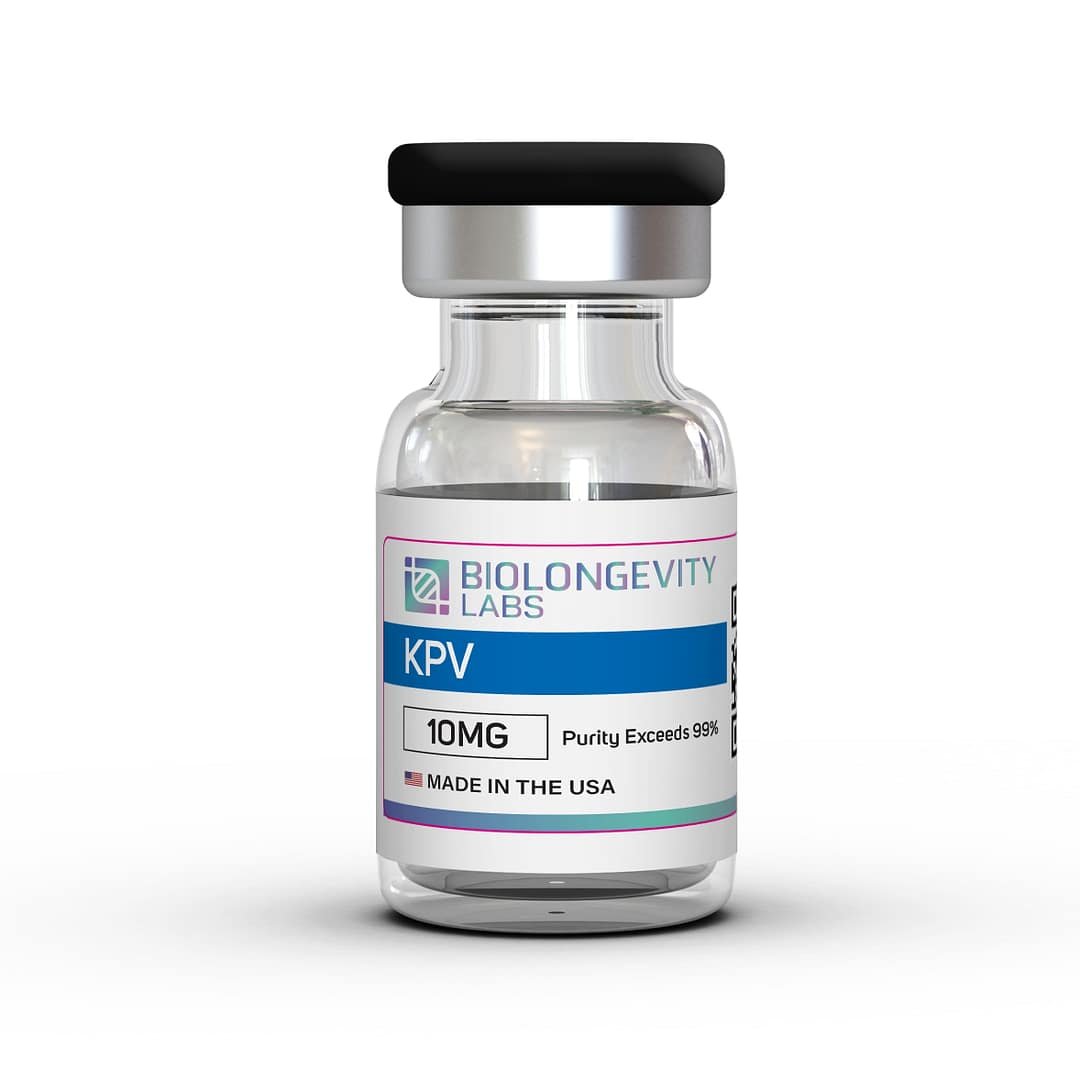
KPV (10mg)
$69.98
KPV (Lys–Pro–Val) is the C-terminal tripeptide fragment of α-melanocyte stimulating hormone (α-MSH). As a small, bioactive peptide, KPV reproduces many of α-MSH’s anti-inflammatory, antimicrobial and tissue-protective activities while avoiding full-length melanocortin receptor signaling in some contexts.
Buy KPV (10mg)
KPV Peptide Product Description
KPV (Lys–Pro–Val) is the C-terminal tripeptide fragment of α-melanocyte stimulating hormone (α-MSH). As a small, bioactive peptide, KPV reproduces many of α-MSH’s anti-inflammatory, antimicrobial and tissue-protective activities while avoiding full-length melanocortin receptor signaling in some contexts.
In research settings, KPV has been studied for:
- Potent anti-inflammatory action — suppresses pro-inflammatory cytokines and leukocyte activation
- Antimicrobial activity — direct candidacidal and bactericidal effects reported for α-MSH C-terminal fragments including KPV
- Mucosal and epithelial protection / wound healing — accelerates epithelial repair in corneal and other epithelial models
- Anti-fibrotic and immunomodulatory effects — reduces fibrosis and shifts macrophage phenotypes in preclinical studies
The KPV peptide sequence is a useful research tool for studying innate immune regulation, mucosal defense and novel anti-inflammatory peptide mechanisms.
Product Specifications
| Property | Value |
|---|---|
| Peptide Sequence | Lys-Pro-Val (H-Lys-Pro-Val-OH) |
| Molecular Formula | C16H30N4O4 |
| Molecular Weight | 342.43 g/mol |
| CAS Number | 67727-97-3 |
| PubChem CID | 125672 |
| Synonyms | α-MSH(11-13), ACTH(11-13), MSH(11-13) |
Lyophilized Peptides:
These peptides are freeze-dried, a process that not only extends shelf life but also preserves the purity and integrity of the peptides during storage. We do not use any fillers in this process.
Product Usage:
This PRODUCT IS INTENDED AS A RESEARCH CHEMICAL ONLY. This designation allows the use of research chemicals strictly for in vitro testing and laboratory experimentation only. All product information available on this website is for educational purposes only. This product should only be handled by licensed, qualified professionals. This product is not a drug, food, or cosmetic and may not be misbranded, misused or mislabeled as a drug, food or cosmetic.
Research Overview
KPV (Lys-Pro-Val) is a C-terminal tripeptide fragment of alpha-melanocyte-stimulating hormone (alpha-MSH, positions 11-13) that has been studied for its anti-inflammatory properties in laboratory settings. Research demonstrates KPV operates through melanocortin receptor-independent pathways, making it distinct from its parent molecule.
Molecular Mechanisms
KPV enters cells via the PepT1 oligopeptide transporter with high affinity (Km ~160 μM in Caco2 cells). Studies show the peptide accumulates in the nucleus within 5 hours, where it competitively disrupts the interaction between p65RelA and importin-α3, blocking NFκB nuclear translocation.[1]
At nanomolar concentrations (10 nM), KPV also suppresses all three major MAPK subfamilies (ERK1/2, JNK, p38) in intestinal epithelial cells. This mechanism occurs independently of melanocortin receptors and reduces inflammatory cytokine expression.[2]
Gastrointestinal Inflammation Models
Oral KPV administration in murine DSS and TNBS colitis models demonstrated significant reductions in:
- Colonic myeloperoxidase activity (~50% decrease, p<0.05)
- Pro-inflammatory cytokine mRNA (IL-6, IL-12, TNF-α, IFN-γ)
- Epithelial damage and inflammatory cell infiltration
- Body weight loss and colon shortening
Research indicates KPV’s efficacy correlates with PepT1 expression, which becomes upregulated in inflamed colonic epithelium and immune cells during IBD (inflammatory bowel disease).[1]
Airway and Pulmonary Studies
In bronchial epithelial cells (16HBE14o-), KPV reduced TNFα-induced inflammatory responses:
- NFκB reporter activity decreased at concentrations ≥1 μg/ml
- IL-8 mRNA reduced by ~35% (p<0.05)
- MMP-9 gelatinolytic activity returned to baseline levels
- Eotaxin secretion significantly attenuated
These findings suggest potential applications in respiratory inflammation research models.[2]
Immune Cell Modulation
Human Jurkat T cells and intestinal immune populations express functional PepT1, enabling KPV uptake. Studies demonstrate that 10 nM KPV stabilizes IκBα protein levels and reduces IL-8 transcription by ~40% following TNFα stimulation.
During inflammatory conditions, PepT1 expression increases in lamina propria macrophages and peripheral T cells, providing disease-activated delivery pathways for peptide-based research tools.[1]
Dermatological Research
KPV retains anti-inflammatory activity without activating MC1R, the melanogenesis receptor. This property makes it useful for skin inflammation research where pigmentation effects would confound results.[3]
Stereoisomers like KdPT (Lys-D-Pro-Thr) show enhanced proteolytic stability. Research on sebocytes demonstrated KdPT suppresses IL-1β-mediated cytokine signaling, relevant to acne pathogenesis studies.
Structure-Activity Relationships
The tripeptide KPV represents the minimal α-MSH sequence retaining anti-inflammatory activity. Deletion studies confirm truncation beyond KPV eliminates efficacy.[4]
D-amino acid substitutions (KdPV, KPdV, dKPV) preserve activity while enhancing proteolytic resistance. Glycoalkylation of the lysine residue increases stability but eliminates antimicrobial properties, demonstrating structure-dependent bioactivity profiles.[5]
Research Use Only: KPV is intended for in vitro laboratory research and experimental protocols. All findings referenced represent preclinical research models and are not validated for therapeutic applications.
References
- 1. Dalmasso G, Charrier–Hisamuddin L, Thu Nguyen HT, Yan Y, Sitaraman S, Merlin D. PepT1-Mediated Tripeptide KPV Uptake Reduces Intestinal Inflammation. Elsevier BV; 2008. https://doi.org/10.1053/j.gastro.2007.10.026
- 2. Land S. Inhibition of cellular and systemic inflammation cues in human bronchial epithelial cells by melanocortin-related peptides: mechanism of KPV action and a role for MC3R agonists. International Journal of Physiology, Pathophysiology and Pharmacology 2012;4 2:59–73.
- 3. Böhm M, Luger T. Are melanocortin peptides future therapeutics for cutaneous wound healing?. Wiley; 2019. https://doi.org/10.1111/exd.13887
- 4. Luger TA, Brzoska T. α-MSH related peptides: a new class of anti-inflammatory and immunomodulating drugs. Elsevier BV; 2007. https://doi.org/10.1136/ard.2007.079780
- 5. Songok AC, Panta P, Doerrler WT, Macnaughtan MA, Taylor CM. Structural modification of the tripeptide KPV by reductive “glycoalkylation” of the lysine residue. Public Library of Science (PLoS); 2018. https://doi.org/10.1371/journal.pone.0199686
KPV (260399)

KPV (11442)

KPV (11217)

KPV (251443)
 ×
×
Disclaimer: For Research Purposes Only
This content is provided strictly for research purposes and does not constitute an endorsement or recommendation for the non-laboratory application or improper handling of peptides designed for research. The information, including discussions about specific peptides and their researched benefits, is presented for informational purposes only and must not be construed as health, clinical, or legal guidance, nor an encouragement for non-research use in humans. Peptides described here are solely for use in structured scientific study by authorized individuals. We advise consulting with research experts, medical practitioners, or legal counsel prior to any decisions about obtaining or utilizing these peptides. The expectation of responsible, ethical utilization of this information for legitimate investigative and scholarly objectives is paramount. This notice is dynamic and governs all provided content on research peptides. . .
Related products