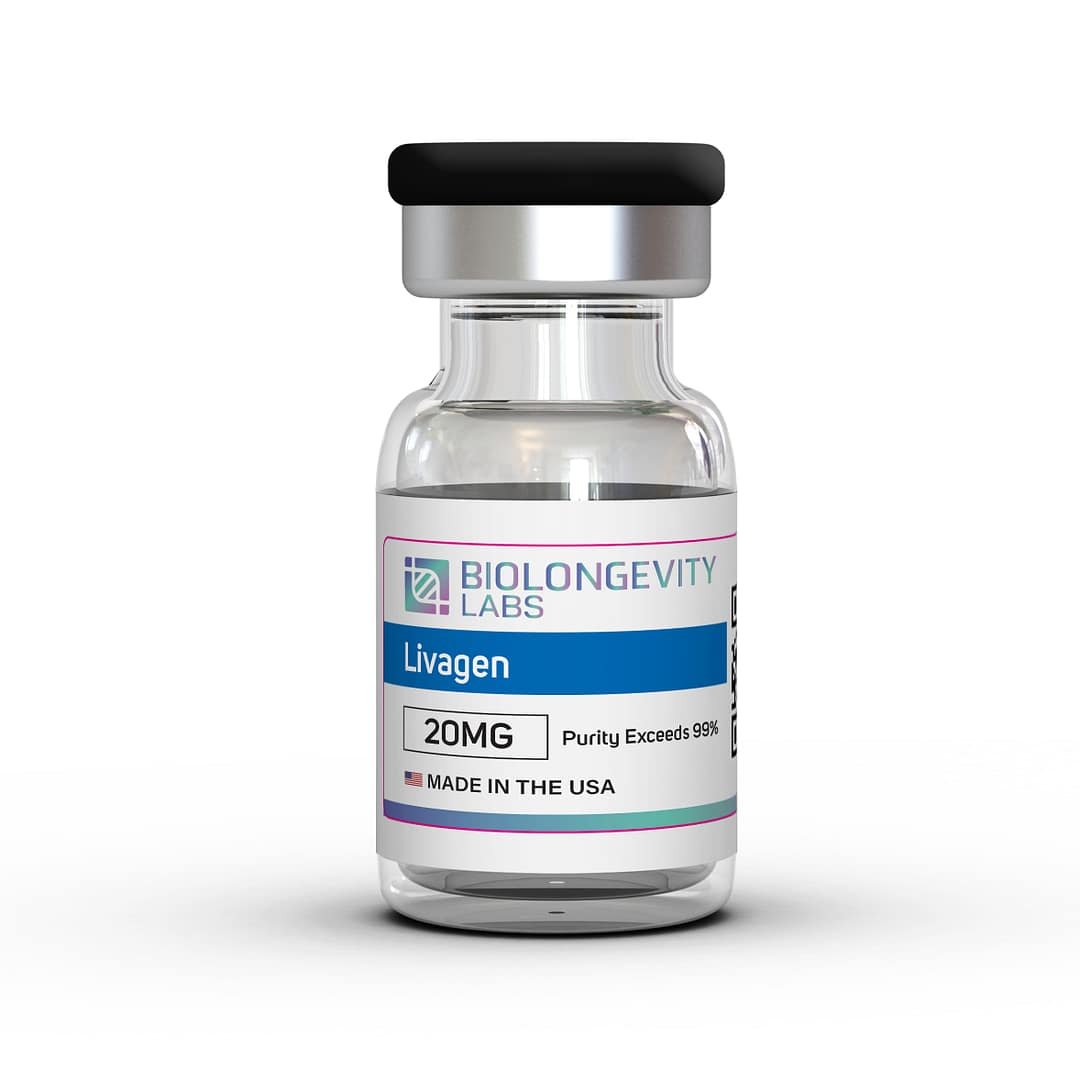
Buy Livagen Peptide (20mg)
Livagen Product Description
Buy Livagen lyophilized peptide (powder) 20mg for maximum stability.
Livagen bioregulatory peptide offers researchers a powerful 20mg bioregulator for studying cellular gene expression and chromatin dynamics. This lyophilized tetrapeptide, based on Khavinson and Malinin’s research, demonstrates significant effects on protein synthesis and chromatin structure in laboratory settings.
The amino acid sequence Lys-Glu-Asp-Ala provides researchers with opportunities to investigate genetic regulation mechanisms. Manufactured to research-grade specifications, this peptide bioregulator supports diverse in vitro applications. Strictly formulated for research use only in qualified laboratory environments.
Peptide Information
| Property | Value |
|---|---|
| Peptide Sequence | H-Lys-Glu-Asp-Ala-OH |
| Molecular Formula | C18H31N5O9 |
| Molecular Weight | 461.5 g/mol |
| CAS Number | 195875-84-4 |
| PubChem CID | 87919683 |
Livagen Research
Livagen peptide (Lys-Glu-Asp-Ala) is a tetrapeptide bioregulator with documented effects across multiple biological systems in laboratory studies. Research demonstrates the effects of Livagen in hepatoprotective, immunomodulatory, epigenetic, and enzymatic pathways, making it relevant for diverse in vitro research applications.
Hepatoprotective & Immunomodulatory Effects
Livagen demonstrates significant hepatoprotective and immunomodulatory properties through multiple mechanisms. Research shows that the tetrapeptideKEDA (Lys-Glu-Asp-Ala) exhibits hepatoprotective, immunomodulatory, and geropprotective properties in experimental models of liver pathology. The peptide functions by normalizing immune and antioxidant status and restoring liver functions during hepatitis conditions[1].
Key mechanisms include:
- Normalization of cellular immune responses during liver injury
- Restoration of antioxidant enzyme systems compromised by hepatic damage
- Enhanced protective effects specifically during aging processes
- Modulation of digestive enzyme activity across different organ systems[2]
Studies demonstrate that maximal hepato- and immunoprotective effects occur during aging, suggesting potential research applications in age-related decline of liver and immune function. The compound shows efficacy in both acute and chronic experimental hepatitis models, with similar protective properties to polypeptide liver complexes[1].
Enzymatic Activity Modulation
Livagen exhibits specific modulatory effects on various enzyme systems, particularly those involved in neuropeptide metabolism and digestion. Research demonstrates that Livagen and Epitalon influence enkephalin-degrading enzymes in serum, suggesting a role in modulating endogenous opioid peptide metabolism[3].
Core mechanisms involve:
- Selective modulation of enkephalin-degrading enzyme activity, potentially affecting pain-related pathways in research models[4]
- Age-dependent responses in digestive enzyme systems, with differential effects observed between young and elderly subjects[2]
- Tissue-specific enzyme responses, with effects noted in both digestive and non-digestive organs[2]
The peptide’s ability to modify enzyme activity appears age-dependent, with more pronounced effects observed in older subjects, indicating potential research applications for age-related enzymatic dysfunction.
Epigenetic and Chromatin Effects
Livagen demonstrates significant epigenetic regulatory properties, particularly affecting chromatin structure and gene expression in aging cells. Research reveals that peptide bioregulators induce epigenetic modifications on “old” chromatin, suggesting potential mechanisms for cellular changes at the epigenetic level[5].
Epigenetic mechanisms include:
- Chromatin modification in aging cells, potentially reversing age-associated epigenetic changes[5]
- Interaction with heavy metals affecting epigenetic patterns during aging, indicating environmental protection mechanisms[6]
- Influence on nucleolar organizing regions (NORs) and chromosomal activity[7]
- Effects on acrocentric chromosome associations, suggesting roles in ribosomal RNA synthesis and cellular metabolism[7]
These epigenetic effects represent a novel mechanism of action whereby Livagen may counteract age-related chromatin deterioration and maintain genomic stability through epigenetic reprogramming.
Thymic Morphology and Development
Livagen exhibits protective effects on thymic structure and function, particularly under conditions of endocrine disruption. Studies using hypophysectomized birds demonstrate that peptides Lys-Glu-Asp-Gly and Ala-Glu-Asp-Gly affect thymus morphology, indicating structural preservation capabilities[8].
Thymic mechanisms encompass:
- Restoration of thymic structure in hypophysectomized animals, compensating for pituitary hormone deficiency
- Age-dependent responses in thymic tissue, with differential effects in young versus old subjects
- Morphological preservation during endocrine disruption, maintaining immune organ integrity despite hormonal imbalances
This research suggests Livagen may help maintain thymic function during aging or endocrine dysfunction, potentially preserving T-cell development and immune competence[8].
Cardiovascular and Genomic Stability
Livagen shows potential cardiovascular protective effects and genomic stability maintenance properties. Research in patients with hypertrophic cardiomyopathy and their relatives demonstrates effects on NORs and acrocentric chromosome associations, suggesting cellular-level protective mechanisms[7].
Cardiovascular and genomic mechanisms include:
- Modulation of chromosomal activity in cardiac conditions, potentially affecting gene expression in heart disease
- Potential role in genomic stability maintenance, as evidenced by effects on chromosomal organization
- Effects on cellular markers in cardiovascular disease, including nucleolar activity and chromosome behavior
Additional research indicates potential involvement in atherosclerosis-related genomic instability, suggesting broader cardiovascular protective mechanisms through maintenance of chromosomal integrity[9].
References
- B. Kuznik, N. Khasanova, G. Ryzhak, I. E. Mezsheriakova, and V. Khavinson, “[The influence of polypeptide liver complex and tetrapeptide KEDA on organism physiological function in norm and age-related pathology.],” Advances in gerontology = Uspekhi gerontologii, vol. 33 1, pp. 159–164, 2020.
- N. M. Timofeeva, V. Khavinson, V. Malinin, A. Nikitina, and V. V. Egorova, “[Effect of peptide Livagen on activity of digestive enzymes in gastrointestinal tract and non-digestive organs in rats of different ages].,” Advances in gerontology = Uspekhi gerontologii, vol. 16, pp. 92–6, 2005.
- N. Kost, O. Sokolov, M. Gabaeva, I. A. Zolotarev, V. Malinin, and V. Khavinson, “[Effect of new peptide bioregulators livagen and epitalon on enkephalin-degrading enzymes in human serum].,” Izvestiia Akademii nauk. Seriia biologicheskaia, vol. 4, pp. 427–9, 2003.
- N. V. Kost, O. Yu. Sokolov, M. V. Gabaeva, Yu. A. Zolotarev, V. V. Malinin, and V. Kh. Khavinson, Springer Science and Business Media LLC, 2003. doi: 10.1023/a:1024809822681. https://doi.org/10.1023/a:1024809822681
- “EPIGENETIC MODIFICATION UNDER THE INFLUENCE OF PEPTIDE BIOREGULATORS ON THE ‘OLD’ CHROMATIN.,” Georgian medical news, vol. 335, pp. 79–83, 2023.
- T. Lezhava et al., “Epigenetic Variations in Chromatin Caused by the Combination of Bioregulators with Heavy Metals During Aging,” Springer Science and Business Media LLC, Jun. 2022. doi: 10.1007/s10989-022-10427-9. https://doi.org/10.1007/s10989-022-10427-9
- “[Effect of peptide bioregulator and cobalt ions on the activity of NORs and associations of acrocentric chromosomes in lymphocytes of patients with hypertrophic cardiomyopathy and their relatives].,” Georgian medical news, vol. 234, pp. 134–7, 2014.
- A. V. Pateyk, L. M. Baranchugova, N. S. Rusaeva, V. I. Obydenko, and B. I. Kuznik, “Effect of Peptides Lys-Glu-Asp-Gly and Ala-Glu-Asp-Gly on the Morphology of the Thymus in Hypophysectomized Young and Old Birds,” Springer Science and Business Media LLC, Mar. 2013. doi: 10.1007/s10517-013-2029-0. https://doi.org/10.1007/s10517-013-2029-0
- T. A. Dzhokhadze, T. Buadze, M. Gaiozishvili, N. Kakauridze, and T. Lezhava, “[Genomic instability in atherosclerosis].,” Georgian medical news, vol. 236, pp. 82–6, 2014.
Livagen (12098)

Livagen (260261)

Endotoxin Livagen

Livagen (251517)

Livagen (251517E)
 ×
×
Disclaimer: For Research Purposes Only
This content is provided strictly for research purposes and does not constitute an endorsement or recommendation for the non-laboratory application or improper handling of peptides designed for research. The information, including discussions about specific peptides and their researched benefits, is presented for informational purposes only and must not be construed as health, clinical, or legal guidance, nor an encouragement for non-research use in humans. Peptides described here are solely for use in structured scientific study by authorized individuals. We advise consulting with research experts, medical practitioners, or legal counsel prior to any decisions about obtaining or utilizing these peptides. The expectation of responsible, ethical utilization of this information for legitimate investigative and scholarly objectives is paramount. This notice is dynamic and governs all provided content on research peptides. . .
Related products